
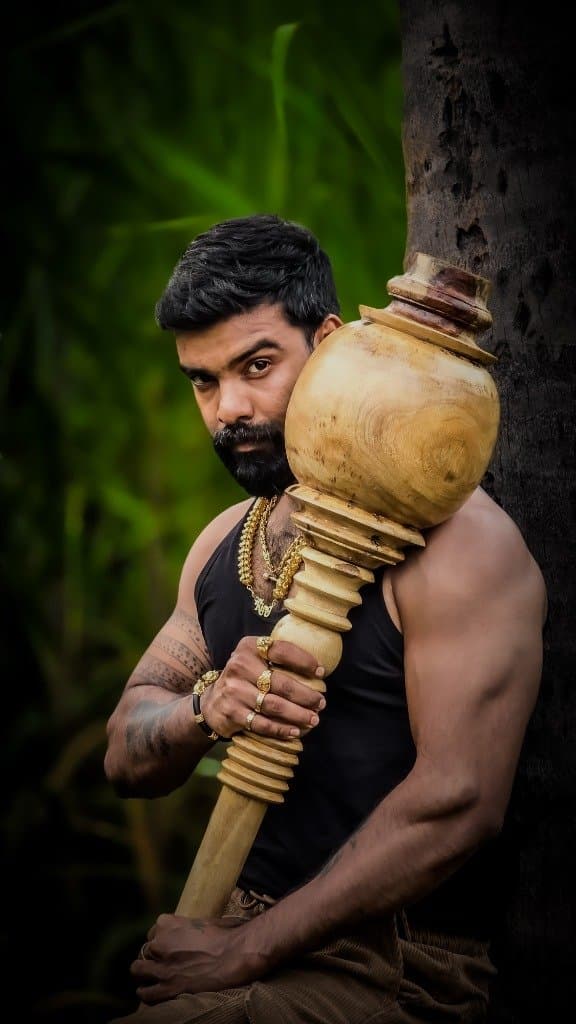
Karlakattai is a traditional Tamil training method that uses a weighted wooden log or club for developing grip strength, whole-body coordination, rotational power and conditioning. It is one of the oldest documented implements in Tamil physical culture.
The Karlakattai — sometimes called a karla or kallu in regional usage — is typically a turned or shaped piece of wood with a handle and a weighted end, used for swings, presses, carries and rotational drills.
What Karlakattai trains
Karlakattai develops grip endurance, forearm strength, shoulder stability, rotational control and cardiovascular conditioning simultaneously. The offset weight demands that the body stabilise through the core while the limbs move — building coordination that transfers to everyday tasks and other training.
Unlike a barbell or dumbbell, the Karlakattai's shape and balance point change through the movement, requiring constant adjustment and awareness. This makes it a demanding tool for both strength and skill.
Documented tradition and cultural context
Karlakattai has been used in Tamil physical culture as both a training tool and a conditioning implement. It appears in traditional wrestling, martial preparation and general physical culture across Tamil Nadu, India.
The implement's design varies by region and lineage — some are simple wooden logs, others are precisely turned with specific weight distributions. The practice has been passed through communities of physical practitioners, though formal documentation of its full history remains incomplete.
Complete historical records, regional variations and specific lineage documentation for Karlakattai training require further research. What is shared here reflects documented use and careful interpretation rather than a complete, verified history.
Wildflow's interpretation
Wildflow does not teach Karlakattai as a historical artefact or cultural exhibit. It uses the principles behind the practice — offset loading, grip demand, rotational movement and whole-body tension — as part of a modern training language.
In sessions, Karlakattai-inspired work might include controlled swings, loaded carries with offset implements, rotational presses and grip-intensive drills. The focus is on what the movement does for the body today, not on recreating a specific historical sequence.
Karlakattai and kettlebell training
Both tools develop grip, power, conditioning and coordination through offset loading. The kettlebell and Karlakattai share functional overlap, though their shapes, balance points and historical contexts differ. Wildflow treats them as parallel traditions that inform each other — not as one descending from the other.
For more on how kettlebells and traditional implements compare, see Understanding kettlebell training.
Related reading
To understand how Karlakattai connects to other Tamil physical practices, read Meipadam explained. For the full comparison between traditional and modern approaches, see Traditional Tamil exercise vs modern fitness.
Structured programs that integrate Karlakattai principles are available at Traditional Tamil Exercise Course.
Train with context
See how these ideas become structured practice in Wildflow programs — or ask a question directly.