
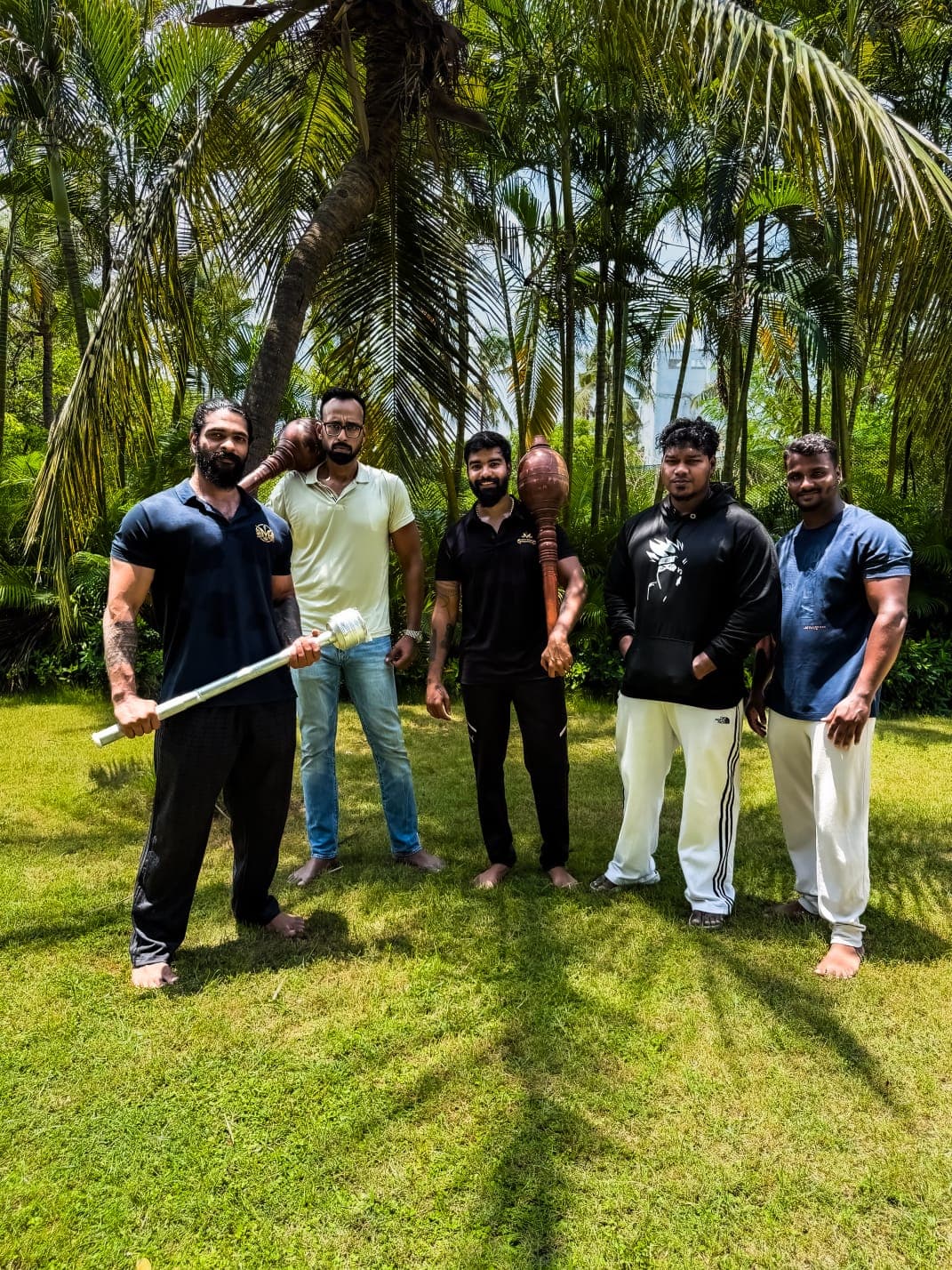
Meipadam is a traditional Tamil practice of body sensing, conditioning and controlled movement rooted in martial and physical culture. It trains awareness of the body's surface, joints and internal responses — developing the kind of control that supports martial readiness, daily function and physical literacy.
In Tamil physical tradition, Meipadam is associated with practices like Varma Kalai and Silambam, where understanding the body's responses under pressure is as important as the external technique itself.
What Meipadam trains
Meipadam develops proprioception — the sense of where the body is in space — along with controlled breathing, joint sensitivity and the ability to absorb and redirect force. It is less about raw power and more about the precision of how the body responds to contact, load and movement.
In traditional contexts, Meipadam was a foundational layer: practitioners learned to sense and control the body before applying it to combat, conditioning or everyday physical work.
Documented tradition and cultural context
Meipadam sits within a broader Tamil physical culture that includes martial systems, conditioning methods and body practices developed over centuries in Tamil Nadu, India. Its exact historical origins and transmission paths vary across lineages and regional traditions.
Specific dates, lineage records and formal documentation of Meipadam as a codified system require further research. These details are not yet established fact and should not be presented as such without verified sources.
Wildflow's interpretation
Wildflow does not claim to teach historical Meipadam as a complete martial system. Instead, it draws on the principles behind the practice — body awareness, controlled tension, sensory training and grounding — and applies them to modern movement and strength contexts.
In Wildflow sessions, Meipadam-informed practice might appear as slow, controlled body scanning, joint articulation under light tension, or breath-linked movement sequences designed to sharpen proprioception before heavier training.
How it fits in Tamil-rooted training
Meipadam sits alongside Karlakattai, Silambam and other Tamil physical practices as part of the cultural layer that informs Wildflow's approach. It is one thread in a larger movement language — not a standalone system.
For a fuller picture of how Meipadam connects to the broader practice, see the article on What is Tamil-rooted exercise? or explore how it compares to modern fitness disciplines in Traditional Tamil exercise vs modern fitness.
Related reading
To see how traditional practices like Meipadam connect to modern training methods, read Karlakattai explained. For structured programs that integrate these principles, visit Traditional Tamil Exercise Course.
This article was informed by the work of Manikandan, founder of Wildflow Thamizhan and founder of Mani's Kingsway, who developed the Tamil-rooted training approach that connects traditional physical culture with contemporary practice.
Train with context
See how these ideas become structured practice in Wildflow programs — or ask a question directly.